


15 Oct The Complete Guide to Alcohol Rehab: From Detox to Aftercare

Most people searching for alcohol rehab are not looking for inspiration. They want to know what will actually happen, either to them or to someone they love, in the first week and in the months after. The honest answer is that alcohol rehab is not a place you go to dry out; it is a structured treatment pathway that begins with assessment, moves through safe withdrawal support when detox is the right step to take, and then into therapy, practical recovery skills, aftercare and relapse prevention.
This article walks through those alcohol treatment stages in the order you are likely to meet them, so you know what to expect at each point and can tell the difference between a programme that offers enough medical, therapeutic and continuing support and one that stops at detox.
Alcohol rehab is a pathway, not a single event
Alcohol rehab is a planned rehabilitation programme for alcohol dependence or harmful drinking, combining medical care, psychological therapy, practical recovery skills and ongoing support. Detox is usually the first medical stage for anyone who is physically dependent, but it is not the treatment itself. Detoxification clears alcohol from the body and stabilises it, which is necessary but limited: it does not touch the reasons someone drank, the habits built around drinking, or the situations that will test them in three months' time. That is why detox on its own so often ends in a return to drinking.
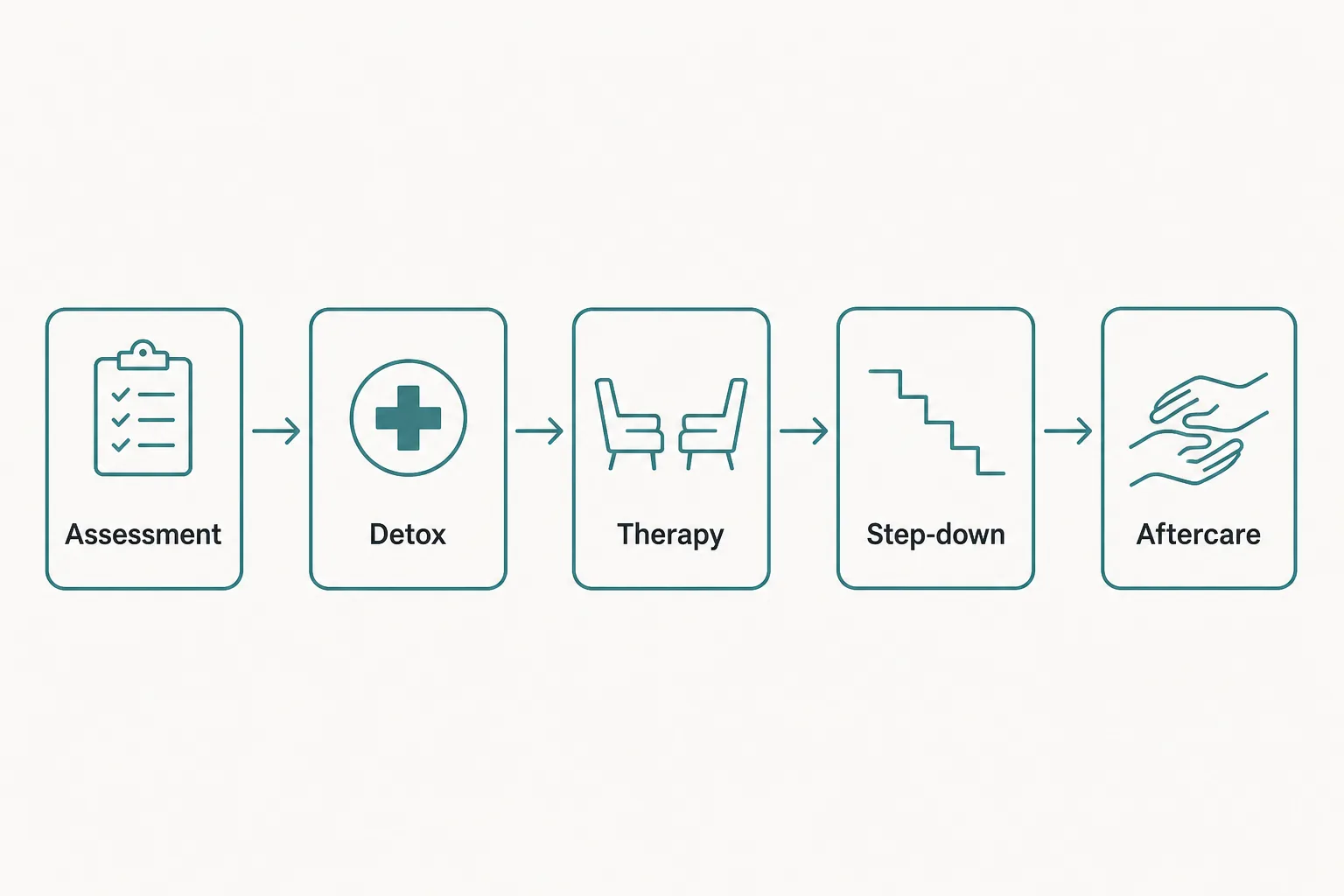
A joined-up pathway looks roughly like this: assessment, detox or stabilisation if clinically needed, therapy and rehabilitation work, family or social support, relapse prevention planning, and aftercare that continues after formal treatment ends. Each stage sets up the next, because stabilisation makes therapy possible, therapy produces the insight and skills a relapse prevention plan is built on, and aftercare keeps that plan alive once the structure of a programme falls away.
What that looks like in practice differs considerably from person to person, since withdrawal risk, physical health, mental health, home environment, responsibilities and personal goals all shape the plan. That is why a credible service assesses before it recommends, rather than offering everyone the same fixed package, and our alcohol rehab programme is built around that assessment from the very first step.
Stage one: intake, assessment and building the treatment plan
The first real contact, whether that is a phone call or an admission appointment, is an assessment. A clinician is trying to establish three things quickly: how much risk there is, how urgent the situation is, and what level of care is appropriate. Honesty here matters more than at any other point, because an underplayed drinking history can lead to an unsafe plan.
Expect questions about the drinking pattern and quantity, how long it has been going on, and what happens when you stop or cut down. Previous attempts to quit are important, as are any past withdrawal symptoms, particularly seizures or episodes of confusion and hallucination, because these predict risk this time around. The assessment should also cover current medicines, physical health conditions, mental health, trauma history and any other substance use, including over-the-counter and prescribed sedatives.
Co-occurring conditions deserve particular attention. Anxiety, depression and PTSD frequently sit alongside heavy drinking, each feeding the other, so a programme that treats the alcohol use while ignoring the mental health picture leaves the engine of the problem running. A thorough assessment flags these so they can be treated together rather than referred away.
The practical side matters too: is there safe housing, are relationships supportive or part of the strain, are there children or caring responsibilities, what are the work pressures, and is there any immediate safeguarding concern. Goals get discussed early as well. For most people that means abstinence, but it usually also includes rebuilding physical health, repairing relationships, learning to cope with stress differently and having a realistic plan for life after formal treatment ends. That conversation becomes the treatment plan.
Medically supervised detox and why alcohol withdrawal needs care
Alcohol withdrawal is one of the few withdrawals that can be genuinely dangerous. With regular heavy drinking the nervous system adapts to the constant sedative effect, so when alcohol is removed suddenly the system rebounds, and symptoms range from anxiety, tremor, sweating, nausea and disturbed sleep through to seizures and delirium tremens at the severe end. We cover the symptom picture and the day-by-day timeline in our separate articles on alcohol withdrawal syndrome and how long detox takes, so this is the short version.
Supervised detox exists to manage that rebound safely. In practice it involves regular monitoring of vital signs, structured assessment of withdrawal severity so that worsening symptoms are caught early, attention to hydration and nutrition, support for sleep, and prescribed medication where it is clinically appropriate to reduce risk and ease discomfort. Medication is a safety measure rather than a cure: it gets someone through the acute phase in a fit state to start the therapeutic work, and it does not substitute for it.
Close medically-supervised detox, often inpatient, becomes especially important where there has been heavy or prolonged daily drinking, previous severe withdrawal, any history of withdrawal seizures or delirium tremens, significant physical illness, pregnancy, complex medication needs, concurrent drug use, or where home is unsafe or support is thin. The key safety point is simple: if you may be physically dependent on alcohol, do not assume you can stop abruptly on your own. Speak to a doctor or a treatment service first and let them judge the risk.
Therapy: the work that follows stabilisation
Once the body is stable, the real rehabilitation begins. Therapy has two jobs: helping someone understand the patterns that sat underneath the drinking, and building practical, rehearsed ways of responding to cravings, difficult emotions, stress and specific triggers without reaching for alcohol. One without the other tends not to hold.
One-to-one counselling is where the personal material goes, so it covers history, motivation and ambivalence, shame, grief, trauma, strained relationships, and the individual pattern of relapse risk that no group can map for you. Group therapy does something different, offering shared learning, accountability, practice at saying difficult things out loud, and relief from the isolation that heavy drinking tends to create. Many people find the group the most useful part of treatment, although it suits people to different degrees, and a good programme adjusts the balance rather than insisting everyone needs the same mix.
The approaches used should be evidence-based. Cognitive behavioural therapy works on the thoughts and behaviours that drive drinking and the alternatives that can replace them, while DBT-informed skills help with emotional regulation and distress tolerance, which matters a great deal for people who drank to manage overwhelming feelings. Motivational work addresses ambivalence directly, connecting change to what the person actually values rather than to what others want for them.
Care should also be trauma-informed, which means no blame, a pace the person can tolerate, and recognition that trauma shapes trust, emotional regulation and drinking patterns in ways that cannot be rushed. Where it is appropriate and wanted, family involvement adds another layer: education about dependence, work on boundaries and communication, and honest rebuilding of trust, while making clear that loved ones support recovery rather than carry it. And because mental health symptoms and alcohol use so often reinforce each other, dual-diagnosis capability is not a nice extra; a strong programme assesses and treats both together.
How long treatment takes and which setting fits
There is no single correct length, and any programme that quotes one before assessing you is selling a package rather than planning care. Residential programmes are commonly structured in blocks of around 30, 60 or 90 days, with outpatient work running for several months and aftercare continuing well beyond that. What determines the right duration is severity of dependence, withdrawal risk, physical and mental health, motivation, safety at home, progress in therapy and the strength of support waiting after discharge.
The settings differ mainly in intensity and distance from ordinary life. Residential or inpatient treatment gives the highest structure, round-the-clock support and separation from triggers, which suits severe dependence, a history of relapse or an unstable home. Day programmes and PHP-style care deliver intensive daily therapy while the person sleeps at home or in supported accommodation. Intensive outpatient programmes typically run several sessions a week over a few hours, and standard outpatient care one to three sessions a week, both allowing work and family commitments to continue, while continuing care is the lower-intensity, longer-horizon layer that keeps someone connected.
Most people do not pick one of these and stay there. A common route is detox, then residential or day treatment, then outpatient therapy, then aftercare, with intensity stepping down as stability grows. When you are deciding where to start, the practical questions are whether the person can stay away from alcohol safely at home, whether support there is reliable, how intense the cravings are, whether mental health symptoms are unstable, and whether previous attempts in less structured settings have ended in relapse.
One mark of quality is worth looking for: a good service reviews progress regularly and adjusts the level of care accordingly. Discharge should follow readiness and a plan, not the arrival of a date on a calendar.
Aftercare and relapse prevention: turning treatment into daily recovery
Aftercare planning starts before discharge, not after it, because the point is to bridge the gap between a highly structured environment and ordinary life, where the pub is on the route home and the stresses that fed the drinking are still there. The plan should be concrete: who provides ongoing therapy and how often, any medical or psychiatric follow-up needed, what peer support looks like, how family will be involved, when check-ins happen, and how work, housing and relationships will be handled in the first weeks.
Peer support is one of the strongest predictors of people staying connected, whether through mutual-aid groups, a recovery community, structured peer meetings or alumni networks. Models vary, from twelve-step fellowships to science-based self-management groups, and no single one suits everyone, so what matters is regular contact with people who understand the territory. Some people also benefit from a period in structured sober accommodation as a transitional step.
A relapse prevention plan should be written down and practised, not just discussed. It names personal triggers, the early warning signs that usually appear days before a drink does, the coping actions that work, the specific people to contact, safe places to go, and what to do if drinking does happen. Alongside that sit the unglamorous routines that keep recovery steady: regular sleep, decent nutrition, movement, a workable way to handle stress, meaningful activity to fill the hours drinking used to occupy, and sensible reduction of avoidable high-risk situations. Our articles on nutrition for people recovering from alcohol dependence and on grey-area drinking go further into those areas, as do our pieces on withdrawal syndrome and detox timing.
It also helps to be realistic about relapse. It is common and it is a risk to plan for, not a moral failure or evidence that treatment was wasted. What it signals is that the current level of support is not enough, and the right response is to tell someone quickly and adjust the care plan, because secrecy and shame do far more damage than the drink itself.
Questions to ask before you choose a programme
When you are comparing alcohol rehabilitation programmes, six things tell you most of what you need to know: a thorough clinical assessment before any recommendation is made; access to medically supervised detox or a clear referral pathway to it; therapy delivered by qualified, accredited clinicians; genuine dual-diagnosis support for co-occurring mental health conditions; family involvement where it is appropriate and wanted; and a written aftercare plan prepared before discharge rather than handed over on the last day.
Turn those into direct questions on the phone. Who assesses withdrawal risk, and what are their qualifications? What happens if detox becomes medically complex, and can you manage that on site or do you transfer? Which therapies are offered, and how is the balance of individual and group work decided? How is mental health assessed and treated alongside the alcohol use? How often is progress reviewed, and what triggers a change in the level of care? What support exists after I leave, for how long, and at what cost? Vague or defensive answers to any of these are informative in themselves.
If you are unsure how much risk is involved, or whether now is the right moment, knowing the signs it's time to get help can guide that first conversation with a GP or a qualified treatment professional before making any change to your drinking. That single conversation is the safest first step, and it costs nothing but the call.
No Comments