


15 Oct How to Get an Australian on Medicare or Private Health Cover Into Rehab: What’s Actually Covered

If you or someone you love needs detox or residential treatment, the first practical question is usually about money: does private health insurance cover rehab in Australia, and will Medicare help? The honest answer is that both can help, but rarely in the way people expect.
This guide walks through what is usually covered in Australia, what usually isn't, where gap costs tend to appear, how costs build up depending on how long inpatient programmes take and what changes if you choose treatment overseas. By the end, you should know which questions to ask before you commit to a programme.
The short answer: what Medicare and private cover usually pay for
Medicare is built around medical services rather than residential programmes. It may subsidise GP appointments, eligible mental health care, referrals to psychiatrists, treatment as a public patient in a public hospital and some public drug and alcohol services. What it generally won't do is pay for a private residential rehab or a private non-hospital programme, and private centres can charge thousands of dollars a week.
Private health insurance fills some of that gap, but only in specific circumstances. It may contribute when you hold the right level of hospital cover and the admission is to an eligible hospital-based psychiatric, detox or rehabilitation programme. Because cover is so policy-specific, the same person might be covered for a hospital admission yet not for accommodation, a non-hospital residential programme, extras therapies or anything delivered overseas.
Even when cover does apply, expect some out-of-pocket costs. These commonly come from excesses, co-payments, specialist fees, medication, psychology gaps, programme fees the fund doesn't recognise, and travel for the patient or visiting family.
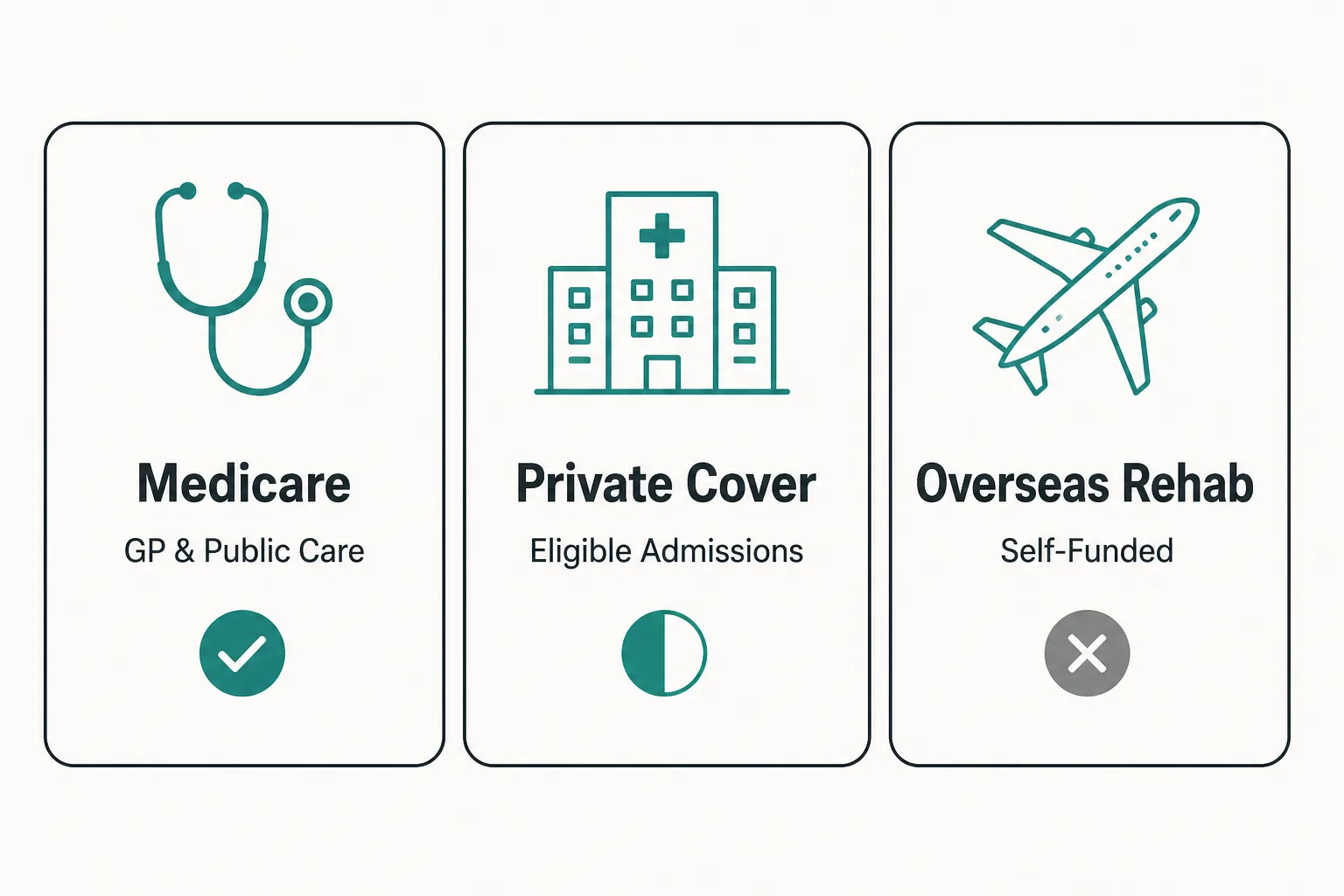
What may be covered by treatment type in Australia
Medically supervised detox is often the first step, and severe withdrawal may be managed through a public hospital, a public drug and alcohol service or a private hospital admission. Which route is funded depends on clinical need and local availability and, for private care, on whether your policy covers the admission.
A public hospital admission is covered by Medicare when you're treated as a public patient, but access is based on assessment and urgency, so you may face referral steps and waiting times. Private hospital-based addiction or psychiatric care is where private health insurance is most likely to contribute, provided your policy includes the relevant psychiatric or rehabilitation benefits and your fund recognises both the facility and the admission.
Residential rehab is where most of the confusion arises, and it helps to understand how inpatient versus outpatient rehab programs are treated differently. In the eyes of a fund, hospital-based inpatient care and a private residential programme are not the same thing, which is why many residential programmes end up self-funded unless they form part of an eligible insured hospital admission or a specific arrangement applies.
Outpatient counselling and psychology may attract Medicare rebates for eligible sessions under a Mental Health Treatment Plan or a psychiatrist referral, although the rebates rarely cover the full fee and session limits apply. GP care and medication support covers assessment, withdrawal planning, referrals and relapse-prevention medication where clinically appropriate. Eligible medicines may be subsidised through the PBS, but appointment and medication gaps can still add up over time.
Does private health insurance cover rehab in Australia? The checks to make before relying on it
Start by separating hospital cover from extras cover, because hospital cover is usually the part that matters for inpatient detox, psychiatric admissions or rehabilitation. Extras might help with a limited number of allied health services, such as some psychology sessions, but it won't fund an admission.
Next, check what your hospital cover actually includes. Look for psychiatric services, rehabilitation benefits and drug and alcohol or detox admissions, and note whether any of these are listed as restricted or excluded. Confirm whether your waiting periods have been served, how any recent upgrade affects them and whether a one-off mental health waiting period waiver might apply to you.
The cost checks matter just as much. Ask about the excess, daily co-payments, annual limits, gap fees, discharge medication and any non-medical programme fees, and always confirm whether a quoted price is before or after fund benefits. Then come the eligibility questions: is the facility recognised by your fund, does the treating doctor have admitting rights, is pre-authorisation required, and will the admission be coded as psychiatric, rehabilitation or something else? A different code can change the benefit entirely.
Finally, ask the insurer for itemised written confirmation before admission, setting out what is covered, what isn't, the expected out-of-pocket cost and any conditions that could lead to a claim being rejected.
How the Medicare pathway works if treatment is in Australia
The Medicare route almost always begins with a GP, who can assess withdrawal risk, mental health concerns and physical health risks, and decide whether urgent hospital care is needed. Depending on severity, they may then refer you to a psychologist, psychiatrist, addiction medicine specialist, public drug and alcohol service or emergency department.
Where appropriate, a Mental Health Treatment Plan can open up Medicare rebates for eligible psychology or mental health sessions. Be clear, though, that this plan supports outpatient sessions only and isn't a way to fund full residential rehab.
Public drug and alcohol services can offer assessment, counselling, withdrawal support, outpatient programmes, pharmacotherapy and referral to inpatient or residential options, although what's on offer varies by location. These services may be low-cost or even free, but they often involve triage, eligibility criteria such as residency status, waiting lists and less choice over timing, location or programme style.
Some situations should never wait for a funding decision. Dangerous withdrawal symptoms, risk of seizures, severe intoxication, psychosis, suicidal thoughts or serious medical complications need emergency help straight away, so call 000 or go to the nearest emergency department.
What changes if an Australian chooses rehab overseas
Australian Medicare doesn't cover overseas rehab, and that includes private residential treatment abroad, flights, accommodation and any medical care received outside Australia. Australian private health funds usually don't cover international residential rehab either, unless you hold a specific overseas health or travel insurance policy, or a policy provision, that expressly includes the service, which is uncommon for addiction treatment.
So never assume a receipt from an overseas programme can be claimed later. If you intend to attempt a claim at all, get written confirmation from the insurer before you travel.
When comparing options, look at the full cost rather than the headline programme fee. That means factoring in treatment, medical assessments, detox arrangements, flights, visas, travel insurance, medication, aftercare once you're home, currency conversion and a contingency for emergencies. Unclear inclusions are a common source of unexpected bills, so ask for everything in writing.
In practice, overseas care such as residential drug and alcohol rehab in Bali is usually self-funded or paid for through other means. The decision therefore tends to come down to the total private cost, how quickly you can be admitted and whether the programme can meet the person's clinical needs, including safe detox, without Medicare or standard Australian fund support.
Your next funding step: confirm the cover before choosing a programme
Before you choose any programme, work through these steps:
1. Gather your policy name, membership number, level of hospital cover, extras cover, waiting period status and any recent upgrades or exclusions.
2. Ask your insurer in writing: is detox covered, is a psychiatric admission covered, is rehabilitation covered, is this specific facility recognised, is pre-authorisation needed, what itemised out-of-pocket costs apply, and what would make the claim invalid?
3. Ask the treatment provider for an itemised quote that separates clinical fees, accommodation, programme fees, medications, assessments, aftercare and any non-refundable deposits.
4. Compare timing as well as price. Public pathways may cost less but take longer, private insured care may still leave gaps, and overseas residential care may be quicker to access but is usually self-funded.
If neither Medicare nor your fund will cover the treatment you need, early release of superannuation may be a separate option for eligible Australians. We explain the eligibility rules and process in our dedicated guide on using your superannuation to fund rehab.
The key takeaway is simple: holding Medicare or private health insurance doesn't mean rehab is covered. Confirm the exact admission type, the provider's eligibility and your written out-of-pocket cost before you commit, so the focus can stay on recovery rather than an unexpected bill.
No Comments