


12 Aug How to Support a Loved One Who Is Going to Rehab Abroad

For most families, the hardest part of overseas treatment isn’t the cost or the flights. It’s the silence. If you’re trying to work out how to support someone in rehab abroad while sitting seven or eight hours behind them in a different time zone, unable to drop in, waiting for a reply that may not come until tomorrow, that silence can start to feel like evidence that something has gone wrong.
Usually it hasn’t. Meaningful support doesn’t depend on constant access; it looks like calm, consistent communication, respect for the structure the clinical team has put in place, steady practical help at home, and honest preparation for life after discharge. Understanding how family visits during inpatient rehab are typically structured can also help set realistic expectations. What follows covers what to say and what to avoid saying, how to handle limited contact and delayed replies, how to organise support at home without enabling, how to look after yourselves, and when to pick up the phone to the centre.
How to support someone in rehab abroad when contact is limited
Expect less contact than you want, especially in the first week or two. Many residential programmes restrict phone and messaging access early on, because distance from familiar triggers, routines and social pressure is part of what makes overseas treatment work, and someone who is still checking their phone every hour is still half at home. The restriction is a clinical boundary rather than a punishment, and it’s rarely a signal that anything has gone wrong.
Bali adds its own layer, because depending on where you are, you may be six to eight hours out of step with the centre, which means calls land in narrow windows and your questions get answered while you sleep. Scheduled family calls are common, and so are the gaps between them. You may also find you can’t simply fly over for a weekend visit, or that visits are only permitted at particular points in the programme.
The single best thing you can do is ask the right questions before admission, while you still have the centre’s full attention. Who will update the family, and how often? Given privacy rules, what written consent does your relative need to sign before staff can share anything with you at all? When does phone or message access open up, and how are calls scheduled around the time difference? Is family therapy or a family programme offered, and at what stage? Who do you contact in an emergency, on which number, out of hours? It is also worth asking what you can send, since letters and care packages lift people on hard days but most centres have their own rules about what may arrive in the post. Working through these questions early is part of what makes choosing rehab in Bali feel less daunting for the whole family.
Once you have that plan, follow it. Repeatedly messaging your relative or ringing the centre outside the agreed arrangement tends to raise everyone’s anxiety, theirs included, and it rarely produces information any faster.
What to say to someone in rehab, and what not to say
Keep it calm, short, non-judgemental and hopeful. Early in treatment people are often carrying a great deal of shame, and they may be defensive or emotionally raw, so a brief message that lands warmly does more good than a long one that asks them to explain themselves.
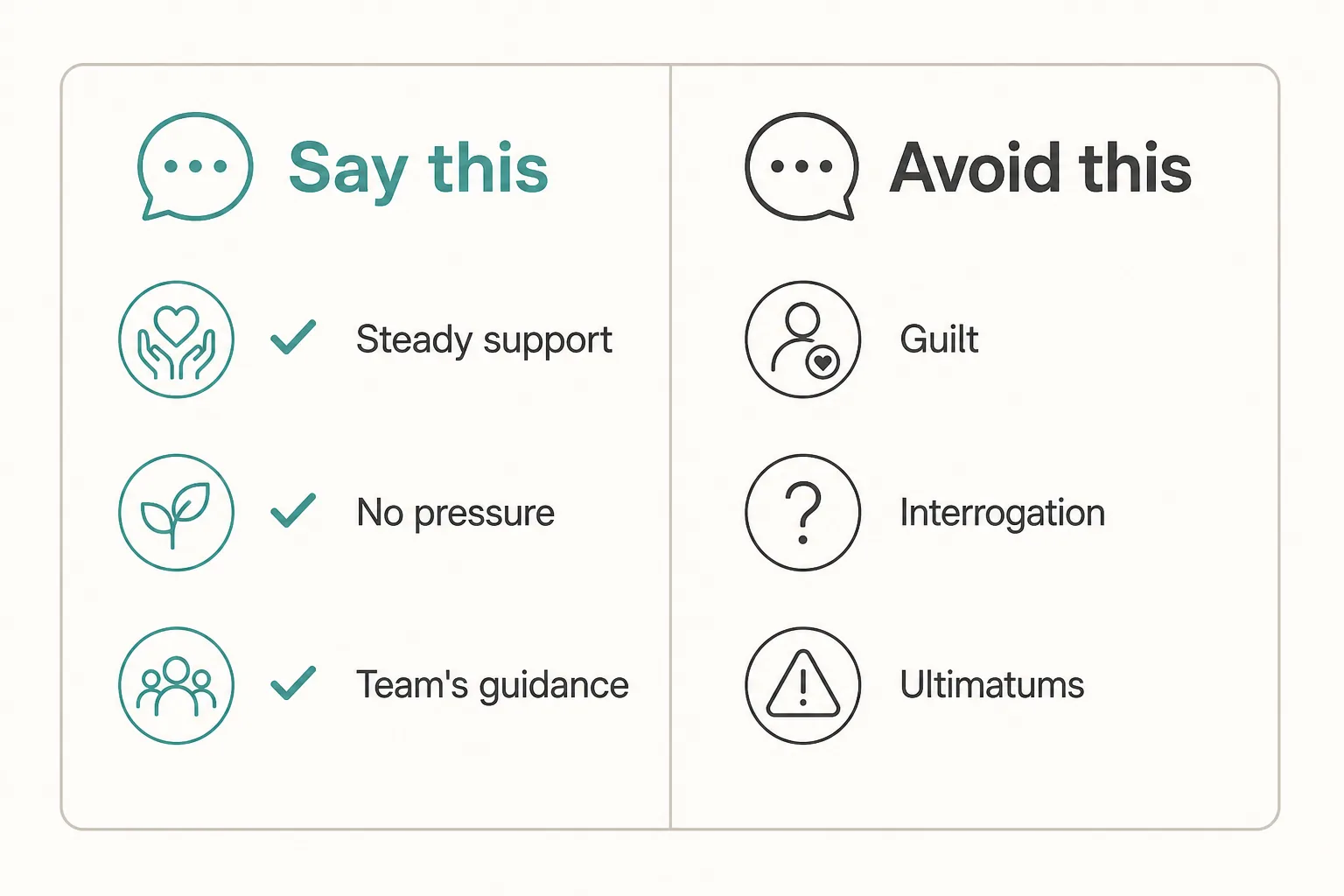
Things worth saying, more or less as they stand: “I’m glad you’re getting support.” “You don’t have to fix everything today.” “I’m proud of you for staying with the process.” “We’re working on our side of things too.” “I’ll follow the team’s guidance so you can focus on treatment.” Notice what they have in common: they offer steadiness without asking for anything back.
What not to say to someone in rehab matters just as much. Avoid guilt (“do you know what this has done to your mother?”), interrogation about their sessions or other residents, blame, ultimatums and threats about what happens if they fail. Avoid minimising it (“you were never that bad”), and avoid comparisons with other people who have recovered or relapsed. Don’t ask them to reassure you that they’re definitely fine now, because that hands them your anxiety to manage on top of their own, and don’t press for a full account of what happened before they’re clinically ready to give one.
Be careful, too, with promises you can’t keep. Saying everything will go back to normal, or that trust is fully restored, or that there will be no difficult conversations when they get home, only sets up a collapse later. Those conversations do need to happen, but they work far better when they’re timed with clinical support, in a family session, rather than raised on impulse during a twenty-minute call that then ends. If you know a hard subject has to be raised, tell the team first so they can support your relative around the call.
Supporting from home without enabling or sending mixed messages
Appoint one or two people as the family’s main contacts. When five relatives all ring the centre and all message the person in treatment separately, information gets garbled, staff time goes on repetition, and your relative receives five slightly different emotional temperatures in a single day. One consistent voice is calmer for everyone.
From there, split the practical load deliberately: decide who passes updates to the wider family, who keeps bills, rent and essential admin moving, who speaks to an employer or handles travel arrangements if that’s needed, and who is looking after children, pets or dependants. Holding things together at home matters more than it sounds, because people going through a hard patch in treatment will often reach for any excuse to come home early, and the fewer genuine reasons there are to leave, the better their chances of completing the programme.
Helpful practical support also means getting the house ready, which includes securing prescription medication with abuse potential in a locked box and thinking honestly about alcohol in the home. Where it tips into enabling is when you cover up ongoing harm, send money without the team’s guidance, make private arrangements behind the clinical team’s back, or step in to remove every discomfort your relative feels.
That distinction matters most when a distressed message arrives. “I hate it here.” “Nobody understands me.” “Book me a flight home.” Ups and downs are normal in treatment, and a message sent at the worst hour of a bad day is not a considered decision, so pause, resist the urge to act, and contact the team for context first. Understanding addiction’s toll on relationships can help you recognise these moments for what they are rather than reacting to them as a permanent verdict on treatment.
Family support during rehab includes looking after yourselves
Family recovery starts while your relative is still abroad, not on the day they land. If there have been years of fear, secrecy, broken sleep and rows, you’re almost certainly depleted, and a few weeks of quiet doesn’t undo that. Get your own support in place now, whether that’s individual therapy, the centre’s family programme if there is one, or a peer support group for relatives, where you’ll find people who recognise exactly what you’ve been living with.
The unglamorous part is routine: keep eating properly, keep sleeping, keep working, keep parenting, keep moving your body, keep seeing friends. Families often let treatment become the only thing happening in the house, checking messages at 3am and organising life around a call window, which leaves everyone exhausted and reactive. Understanding how families can heal together often starts with recognising that these small, steady routines matter just as much as anything happening in treatment itself.
Expect your feelings to be contradictory, because relief that they’re safe, guilt about feeling relieved, anger about what happened, hope and a low hum of uncertainty can all show up in the same week. That’s normal. The practical reason to take your own wellbeing seriously is that a rested, supported family makes fewer panic-led decisions and responds more consistently when a difficult call comes, or when no call comes at all.
One honest caveat: your support genuinely helps, but it doesn’t control the outcome. You can’t love someone into recovery, and you can’t guarantee that relapse will never happen, so holding that lightly protects you from carrying a responsibility that was never yours.
Prepare now for a safer return home
Start planning homecoming well before discharge, not in the week they fly back. Your relative is moving from a highly structured environment thousands of miles away straight back into the triggers, relationships and responsibilities that were there when they left, and much of the real work of staying sober begins at that point. Treatment prepares them for the transition rather than completing it.
Ask the treatment team to walk you through aftercare in specifics: ongoing therapy, recovery meetings locally, any psychiatric or medication follow-up, online support that works across time zones if their therapist remains in Bali, which appointments need booking before they land, and who to call in a crisis.
Then agree the household ground rules together, ideally with clinical input and before they walk through the door. Cover alcohol and drugs in the house, visitors, money and access to accounts, transport, when they return to work and at what pace, privacy, sleep, phone use, and what family communication should look like in the first few weeks. Talk openly about known triggers, old flashpoints in family conflict and relapse warning signs. Agreeing all this in advance isn’t surveillance; steady is the aim, not controlling, because monitoring someone’s every movement corrodes trust as fast as ignoring the risk does.
A relapse plan should be equally concrete: who gets called first, what immediate steps follow, which boundaries apply regardless, and at what point professional help is needed again. Written down, it stops a frightening moment turning into an argument.
Finally, know when to contact the rehab team rather than wait. Get in touch if agreed contact is missed in a way that feels unusual, if your relative is threatening to leave the programme, if messages become frightening, confused or out of character, if there are signs of relapse risk, if you have medical or mental health concerns, if there’s any talk of self-harm, or if a family dispute at home is escalating in a way that could undermine their treatment. Raising something early and being told it’s nothing to worry about is a far better outcome than staying quiet out of politeness.
No Comments