


15 Oct How Long Does Rehab Take? Program Lengths from 28 Days to 90 Days Explained

If you're weighing up rehab for yourself or someone you love, the question of how long does rehab take is rarely abstract. It decides how much leave to request, who looks after the children and whether the bills can wait. The plain answer is that most inpatient programmes run from about 28 to 90 days, although detox can add several days at the start and support continues for months after the residential stay ends.
This guide explains what 28, 60 and 90 days allow for clinically, which factors should shape the decision, including inpatient versus outpatient rehab, and how aftercare changes the picture. The aim is to help you talk to a treatment provider about the right length based on clinical need rather than convenience alone.
How long does rehab take? The short answer before you choose a programme
Many residential programmes are built around 28-day, 60-day and 90-day stays, and some run longer still. It's worth treating these as planning ranges rather than finish lines, because discharge marks the end of one phase of care, not the point at which recovery is complete.
The first thing to separate is detox from therapy. Withdrawal management usually happens before or at the start of rehab and, depending on the substance, can take anywhere from a few days to two weeks, and knowing when medical detox is needed is part of planning that stage safely. That time is necessary, but it isn't where most of the therapeutic work happens. A 30-day stay that begins with a 10-day detox leaves roughly 20 days for therapy, which changes what a shorter programme can realistically achieve.
The second is what happens afterwards. Continuing care, such as ongoing therapy, peer support and relapse-prevention check-ins, is part of the treatment timeline rather than an optional extra. So the honest answer to how long is inpatient rehab is that it depends on a clinical assessment of risk and readiness, not on which option is cheapest or easiest to fit around work.
What 28-day, 60-day and 90-day rehab programmes usually make possible
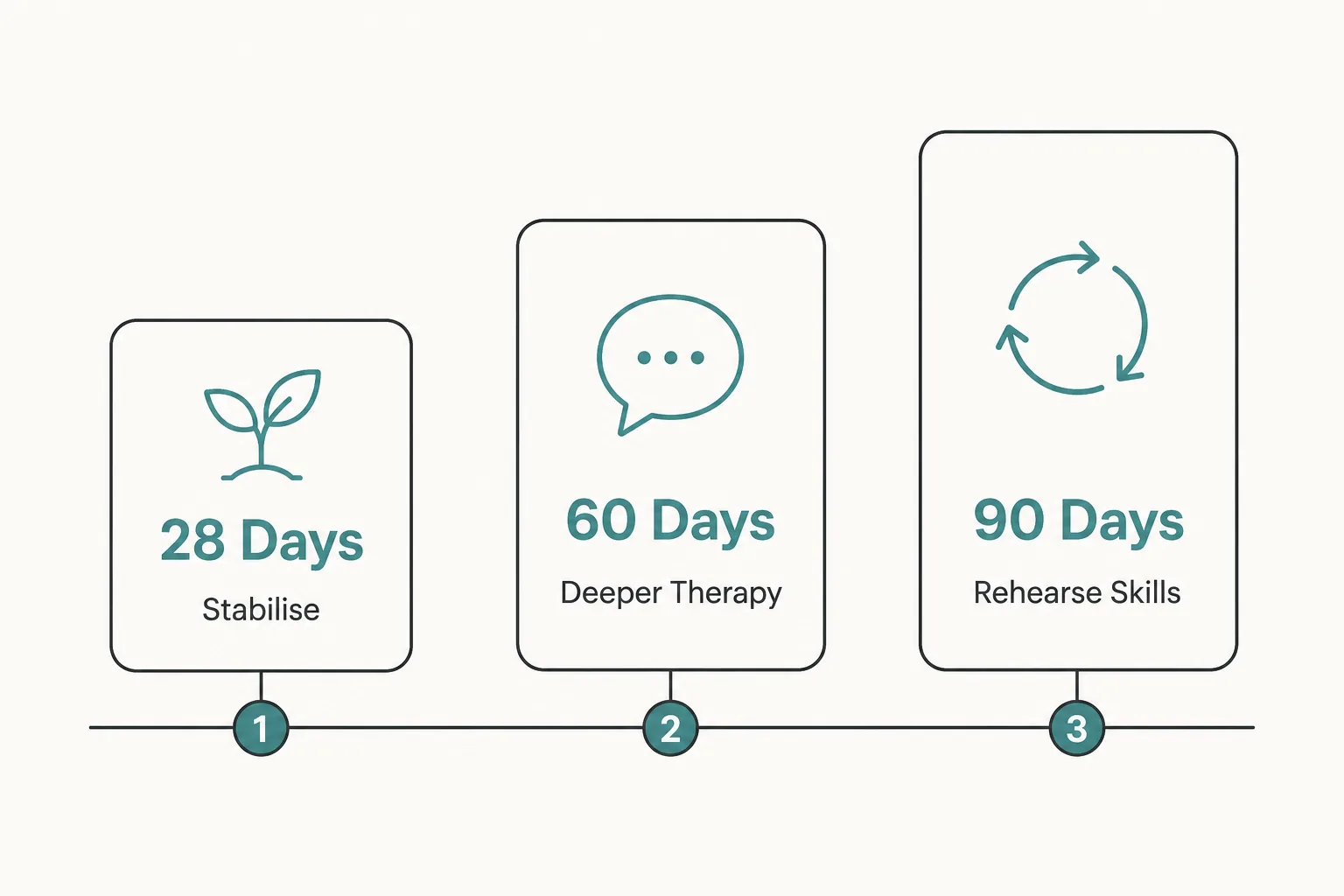
A 28 day rehab program is a focused start, and it sits at the shorter end of the typical inpatient programme durations. It can cover detox or stabilisation, introduce individual and group therapy, help someone identify their triggers and begin a relapse-prevention plan, alongside arrangements for structured support after discharge. For someone with a shorter history of use, no significant co-occurring mental health condition and a strong support network at home, that can be a sensible foundation to build on through outpatient care.
The limitation is time. Once detox is complete, there may be only two to three weeks of intensive work left, which is rarely enough to address deep trauma, stabilise a complex mental health condition, begin repairing family relationships or practise new coping skills often enough for them to become habits.
At 60 days, therapy can move beyond crisis management and into the patterns that keep substance use going. Sleep tends to improve, thinking becomes clearer and emotional reactions settle, which gives therapy a much better chance to land. There's also room for more family involvement and more detailed discharge planning, so a 60-day stay often suits people with moderate histories and conditions such as anxiety or depression.
A 90 day rehab programme isn't simply more of the same. It can suit people with long-standing dependence, previous relapses, complex withdrawal, a dual diagnosis, a trauma history or an unsafe home to return to, because it gives them time to rehearse recovery skills again and again in a structured setting before facing ordinary life. Put simply, longer programmes create more clinical room for stabilisation, deeper therapy, relapse-prevention work and a careful transition home.
The factors that should determine how long inpatient rehab is
The right length starts with the substance and its withdrawal risk. Alcohol and benzodiazepine withdrawal often need longer and more medically intensive monitoring than opioid withdrawal, while stimulants and polysubstance use bring their own pacing challenges. The longer and more supervised the detox, the less of a short stay is left for therapy.
Severity and duration of dependence come next, since daily, heavy or many years of use usually needs more time than a shorter or less entrenched pattern. Treatment history is just as telling: if someone has relapsed after outpatient care or a previous short stay, that suggests a longer residential programme or a stronger step-down plan this time.
Mental health is often the deciding factor. Depression, anxiety, PTSD, bipolar disorder, unresolved trauma or marked emotional instability all need time to be properly assessed, stabilised and treated alongside the addiction, and some symptoms only become clear once detox is over. Physical health affects the pace too, because medical complications, poor sleep, malnutrition, chronic pain or medication needs can all slow treatment down.
Finally, think about what the person is going home to. Easy access to substances, unstable housing, relationship conflict, heavy work stress or a thin recovery network all make discharge after a short stay riskier, because the old triggers are waiting on day one.
Why longer treatment engagement often helps, but 90 days is not automatically right
The evidence points in a consistent direction: staying engaged in treatment for an adequate period is associated with better outcomes. That makes sense, because changing behaviour, building relapse-prevention skills and steadying mood all depend on repetition over time rather than a single burst of insight.
The commonly cited benchmark comes from the US National Institute on Drug Abuse, which notes that treatment lasting less than 90 days is of limited effectiveness for many people. The same body is careful to say there's no predetermined length that suits everyone, so this isn't a rule that every person needs 90 days, nor a promise that 90 days guarantees recovery. Most people need many months, often the better part of a year, before sober living starts to feel ordinary, and much of that happens after residential care.
Quality and continuity matter as much as the calendar. A shorter residential stay followed by strong aftercare may well be safer than a longer stay that ends with a vague discharge plan. That's also why length should be reviewed during treatment rather than fixed in advance; once detox is complete and therapy has begun, the clinical team often has a much clearer view of what the person actually needs, and a good programme can extend a stay when the evidence supports it.
Choosing the shortest safe stay and the aftercare it will require
The practical pressures are real. Cost, work leave, childcare, family duties and, for anyone travelling abroad for residential drug and alcohol rehab in Bali or any other overseas programme, visas, flights and time zones all shape what feels possible. Those concerns deserve a proper hearing, but they need to be weighed against the risk of under-treating the addiction. Leaving too soon can mean walking back into the same triggers before withdrawal, cravings, mental health symptoms or new coping skills have settled, and a relapse usually costs far more time than a planned extra few weeks.
Aftercare changes what any given length means. A 28-day stay can be clinically sensible if it leads straight into outpatient therapy, recovery coaching, peer support, family support and a clear relapse-prevention plan, whereas the same 28 days with nothing arranged afterwards is a much bigger gamble.
Before committing to a number, take these questions into your assessment:
1. What level of detox is needed, and how long is it likely to take?
2. What relapse risks are present, including previous treatment attempts?
3. Are there mental health or trauma needs that require integrated care?
4. Is the home environment safe to return to?
5. What support will be in place after discharge, and who will coordinate it?
6. What signs would mean extending the stay?
The practical takeaway is simple: choose the shortest programme that still allows enough time for stabilisation, meaningful therapy, careful discharge planning and a realistic continuing-care plan. If a provider can't explain how its recommendation meets each of those, keep asking until it can.
No Comments